_PNG.png)
How Neuropsychological Testing Confirms or Rules Out ADHD

Karolina Nicewicz, PsyD | MindWell Neuropsychology
ADHD is one of the most commonly discussed concerns when a child struggles with attention, focus, or school performance. However, attention difficulties can arise from many different causes. A child who appears distracted or disorganized may be experiencing a variety of underlying factors, not all of which are ADHD.
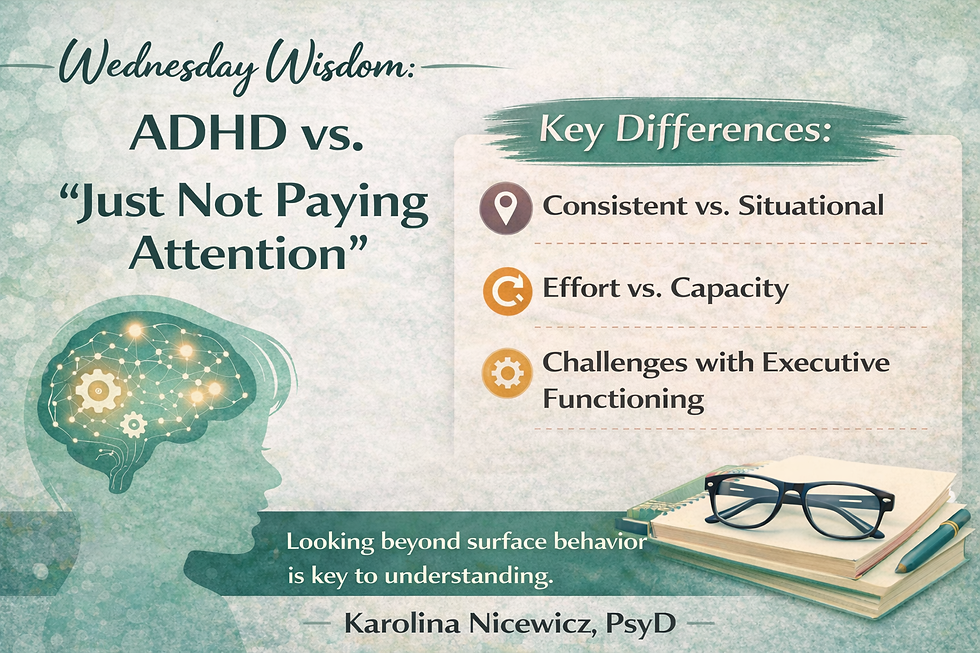
As a neuropsychologist, my role is to look beyond surface behaviors and understand how a child’s brain is functioning. Neuropsychological testing allows me to examine the cognitive processes that influence attention, learning, and behavior. By carefully evaluating these patterns, I can determine whether ADHD is truly present or whether another explanation better accounts for the challenges a child is experiencing.
Looking Beyond Attention
how-neuropsychological-testing-confirms-or-rules-out-adhdADHD is often thought of simply as difficulty paying attention, but the condition actually involves several cognitive systems working together. In my evaluations, I examine areas such as:
Sustained attention
Working memory
Processing speed
Impulse control
Executive functioning
Cognitive flexibility
These abilities influence how children organize their work, manage responsibilities, regulate behavior, and complete tasks both at school and at home.
When ADHD is present, testing often reveals a recognizable pattern of strengths and weaknesses across these cognitive functions.
Understanding the Whole Child
Before testing begins, I take time to understand a child’s broader developmental, academic, and emotional history. Attention difficulties can sometimes emerge in response to learning challenges, emotional stress, or other developmental factors.
Looking at the full context allows me to interpret testing results more accurately. My goal is not simply identifying a diagnosis but understanding how the child thinks, learns, and processes information overall.
This broader perspective is what makes neuropsychological evaluations so valuable.
What Neuropsychological Testing Measures
During the evaluation, children complete a variety of structured tasks that assess different aspects of cognitive functioning. These activities may involve memory exercises, attention tasks, problem-solving activities, or processing speed challenges.
While these tasks may feel like puzzles or games to the child, they provide important insight into how efficiently the brain is managing key skills required for learning and attention.
Through testing, I can evaluate questions such as:
How well a child can sustain attention over time
Whether they can hold and manipulate information in working memory
How quickly they process information
How effectively they organize and regulate their responses
The pattern that emerges across these tasks often provides strong evidence that either supports or challenges an ADHD diagnosis.
When Attention Difficulties Are Something Else
One of the most important parts of a neuropsychological evaluation is determining whether attention difficulties truly reflect ADHD or whether another issue may be contributing.
In some cases, what initially appears to be ADHD may instead be related to:
Learning disorders
Anxiety
Depression
Language processing weaknesses
Reduced processing speed
Sleep or emotional factors
Without careful evaluation, these conditions can sometimes be mistaken for ADHD. Neuropsychological testing helps ensure that children receive the most accurate understanding of what is happening.
Turning Insight Into Support
After the evaluation is complete, I carefully analyze the results and prepare a comprehensive report. This report outlines the child’s cognitive strengths, areas of difficulty, and whether ADHD criteria are met.
Just as importantly, the evaluation includes specific recommendations designed to support the child’s success at school and at home. These may include academic accommodations, learning strategies, or interventions that target executive functioning and attention skills.
My goal is to provide clarity and practical guidance that can help a child move forward with greater confidence.
The Value of Understanding
When children struggle with attention, frustration can develop quickly — both for the child and for the adults trying to help them.
Neuropsychological testing replaces guesswork with understanding.
By identifying how a child’s brain processes information, I can help parents, educators, and clinicians support the child in ways that truly match how they learn.
And when children receive the right support, their confidence and potential often grow in ways that may not have seemed possible before.

Comments